

Her wood chair started to squeak horribly. Blink, the needle stabbed through the fabric once, plicking into it. A sudden breeze came from the window on her left. She glances at the girls flipping pages as they finish each stitch, noting another breeze coming from that ugly window, next to a white wall, well, not quite “white”. The water drips from the ceiling. Although she is unbothered, it seems like she has lived through too much to step away from her needle, which has become her escape. The breeze blows her short, black hair; she’s free, her eyes say it. She is almost finished, and so she grabs both ends of the thread and “snip,” she is done. She sighs in relief and looks up as her name is called: Coco Chanel.
Many would agree they recognize this name, since it’s a mainstay in luxury fashion. The scene noted comes from Chanel’s biography when she recalls how she entered the world of fashion. Given her upbringing as an orphan, Chanel highlighted how creating beautiful clothing allowed her to escape from this harsh environment. However, in today’s world, many find it difficult to afford luxury brands, especially those designed by Coco Chanel.
Luxury brands have a story behind them, and each designer wants a legacy to imply, one in which they want to ensure they follow their values and beliefs. Yet, over time, what began as Chanel’s pursuit of liberation transformed into a symbol of exclusivity. Fashion through decades has gained different meanings impacting prices to individuality. And thus, some have turned to thrifting as it allows them to seek fashionable clothing at an affordable price and an opportunity to express who they are.

With fashion choices now running the risk of costing anywhere from $200 to $1,000, according to prices for various tops and bottoms from Lululemon and Chanel, students find themselves looking to thrift stores not only to save money, but to find pieces for self-expression. According to TeenVogue, most teenagers want to find ways to avoid paying more for their clothes, especially because roughly 98% of clothing is made outside the United States. For instance, some popular brands, like Zara and H&M, have been affected by recent tariffs, according to a May 2025 Marie Claire article. In addition, students noted how thrifting allows them to show who they truly are. According to Coveteur, a multimedia brand company, Gen Z finds thrifting to allow them to find meaningful pieces of clothing, reflective of who they are.
How does thrifting save money?
Thrifting began to boom in 2021 because of Covid 19, leading to the demand of much affordable pieces of clothing. According to the World Economy Forum, with this boom came many reasons, including the sheer amount of money saved. For instance, according to NBC News, you are able to save more money on clothes from the tariffs incorporated this year, purchasing a simple pair of sandals at $153 with an original retail price of $875 if you thrift.

“If someone doesn’t want expensive clothes, someone could go to the thrift store and buy,” said Alicia Terzinski, freshman.
Although the purchase of used clothes is a practical idea, negative social perception can discourage people from buying from secondhand shops. Social risk refers to the fear of judgment among society based on the products one uses or buys. This is often viewed as what would others say. According to SpringerOpen, a peer-reviewed publisher of journals, people worry how their peers perceive them and will wonder if sustainability clothing is viewed as cheap or unfashionable.
“I started reminding myself that clothes don’t really matter,” said Ashley Pionke, sophomore. “If I find clothes that are affordable and I like and I feel good in, then that’s all that really matters. I love to express my interests through my outfits, and I love to pick a piece that might seem obscure for some people and may think is weird, yet, I think is cool.”
However, some teens have turned to fast fashion as it can be affordable. Fast fashion includes rapidly produced clothing made cheaply to meet high demand, according to Brittanica. But given the style of production, it sacrifices the quality of the products, according to Economics Observatory, an online journal forum. Meanwhile, many say thrifting offers clothes with a better value, and according to the 2024 OfferUp Recommerce Report, a commerce research company, 62 % of consumers believe that used apparel offers better quality for the price compared to new retail items. Moreover, based on FashionDive, a fashion journal, resold t-shirts and shoes are worn about 30% more than fast fashion.
“Fast fashion gives us more clothes at a low quality,” said Elizabeth Meersman, teacher of the Family Consumer Sciences department. “The clothes aren’t lasting as long. I’ve even noticed my own children’s clothes where my son’s not even able to make sweatpants last through the winter because they get a hole in them.”
This is why many teens have instead turned to seeking out secondhand items to achieve higher quality that lasts longer. Others cited how thrifting is the more ethical choice as well, given how fast fashion has been linked to environmental and human right concerns, according to the Economics Observatory.
How thrifting allows students to show who they truly are
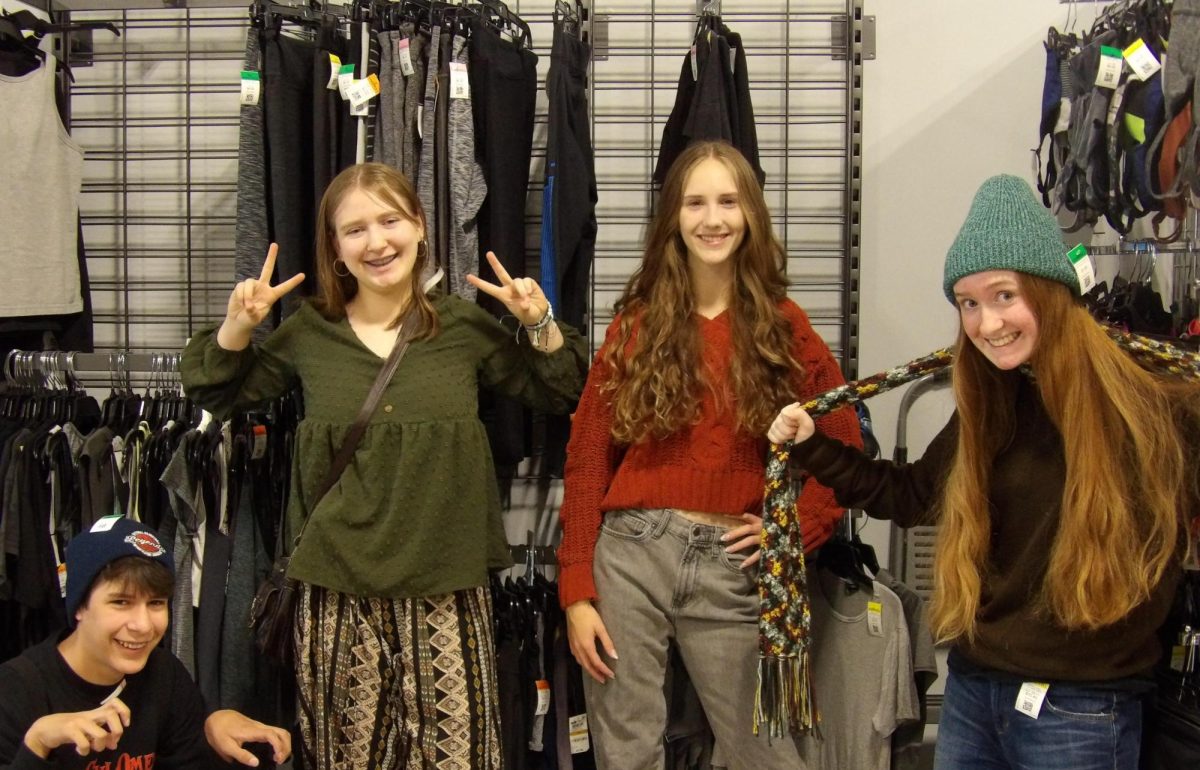
Aside from the savings, students find themselves opting for a thrift store in order to find pieces reflective of who they are. Pionke says the experience of thrifting has allowed her to go against the trends in order to show more of who she is.
“I want my fashion to show that I’m fun and I’m not afraid to be myself. I feel like when people wear clothes, it’s not to show themselves, but to fit in,” Pionke said. “With thrift, I can find cool clothes and say ’Hey, I’m fun’.”

Thrifting has allowed people to express identity and personal style. Additionally, fast fashion pushes trends among social media, limiting the potential individuality. Teens are turning to thrifting to create unique looks. According to a Marie Claire article, TikTokers expressed their usage of thrifted pieces to help them build a personal wardrobe with self-identity.
“I would say some people would slowly have more [self-expression thrifting],” said Damian Ferrer, junior. “Some people would start to express themselves.”
However, there are those who prefer to blend in with the trends because they enjoy them.
“I definitely try fitting in,” said Coco Zahn, sophomore. “I know that I choose most of my outfits based on what other people are wearing.”
Belonging into society for a teen nowadays seems like an easier option. According to a 2025 Pew Research Center survey, adolescents feel certain pressure to look good, with 47% to 49% saying they have the need to fit in socially.
But for those who want to embrace certain designers, again, this is something achievable by thrifting, according to some students.
“I would like them to think that I’m not a follower in any kind,” Ferrer said.
Most thrift shops, like Plato’s Closet, pride themselves in offering name brands. In this way, students can save money, but highlight the fashion, and maybe even show a bit of personality.
The influence of others on students on what brands they wear usually depends on how popular these brands are. According to Psychology Today, “The need for acceptance is a basic human instinct – although some value it more than others. We all want to fit in, to belong. In order to achieve that, we often present slightly different versions of who we are, depending on the environment and whose company we are in.”
“I feel the need to fit in sometimes, especially with my clothing too,” Zahn said. “If there wasn’t luxury culture, then I think people would be more confident in their clothes and in themselves.”
So, when considering the prices of Lululemon and Chanel, teens can still “fit in” but find ways to save money by thrifting, according to those who thrift. When it comes to self-expression, thrifting offers a variety of options for teens to potentially show individuality among a society whose preliminary object is to blend in.
“[Teens] limit themselves by only purchasing certain brands or only wearing what other people do,” Meersman said. “I sometimes think that it’s a sense of belonging or fitting in to be comfortable, but my advice is [trying new] fashion can be awesome.”