


Around school, it’s not uncommon to overhear students discussing their relationships; and, of course, romantic relationships are included in that, particularly around Valentine’s Day. But, for the past several years, terms like “talking”, “situationship” or “seeing someone” have become a part of the broader romantic lexicon, particularly for teenagers. While many of the core challenges of relationships, romantic and non-romantic, remain constant, many of the more straightforward and clearly-defined portrayals of adolescent relationships often seen in older media and stories are gradually on the way out, according to the Pew Research Center.

This isn’t an exclusively recent trend. Going as far back as 2015, their data found that only 14% of teenagers described their current relationship as “serious”, while more than 35% described having been in a relationship previously and the remaining 65% describing themselves as never having dated someone, suggesting that more traditional romantic relationships aren’t as common as they may have been in the past.
At the same time, those interactions are increasingly becoming digital. That same study reports that digital communication, whether that be text messages, social media or phone calls, dominate how teenagers form and navigate relationships. The study also describes how the introduction of social media has complicated the interaction dynamics, with behavior and frequency of interactions and related assumptions often becoming a central issue.
Taken together, these trends suggest that while more traditional relationships may be somewhat declining, romantic interaction between students still exists.
For school social worker Matthew Swies, a lack of clarity such as this can often contribute to strain and stress in any kind of relationship, romantic or otherwise.
“It’s usually coming from a place of not being on the same page as the other person,” Swies said. “One person has one perception of how things are going and they may have assumptions or be frustrated about how the other person isn’t interacting with them in the way they want.”
Another social worker, Peter Hutcheon, notes the changes in and lack of clarity of some relationships.
“The meaning of the term ‘dating’ has changed,” Hutcheon said. “It can mean a lot of different things in terms of relationships, and I think the formal conversation in regards to what the relationship officially is has become less common.”
Swies said how assumptions, particularly those in concerns to how a relationship stands, can cause problems.
“Not jumping to conclusions [is helpful],” Swies said. “We all do this, but sometimes we’ll develop this notion of what the other person wants or is thinking.”
He also said how communicating effectively can help alleviate some of the problems that may naturally arise.
“I think communication goes a long way,” Swies said. “That could look like making a request if another person isn’t meeting you where you want to be met.”
According to Swies, the internet and social media have drastically changed the landscape of teen relationships.
“Years ago, when people didn’t have phones, you had to meet people in social settings, whether that be dances, school activities, parties, or things like that,” Swies said. “Now, I think there’s a barrier when it comes to meeting people online. It can be hard to bridge that gap of perspectives from being in front of someone to being behind a screen.”
Hutcheon said digital communication can be a potential cause for relationship issues.
“A lot of times, [issues tend to be caused by] a miscommunication that isn’t happening face-to-face,” Hutcheon said. “I think there’s a lot of value in speaking face-to-face because subtle things like sarcasm, tone or facial expressions can be picked up on, which helps resolve conflict more than trying to solve it over text.”
On the other hand, the Pew study described how many teenagers believe social media is positive for relationships, with 59% of teenagers stating that it helps them feel more connected.
Hutcheon said that many conflicts escalate because conversations happen over text rather than in person.
“I typically will ask students if they’ve talked to them face to face,” Hutcheon said. “They’ll say ‘no, I haven’t. We’re ignoring each other in the halls, and we’re just texting about it’ and that’s not ideal.”
He said resolving conflict digitally often makes misunderstandings worse.
“I then usually try to steer the conversation towards ‘I think there’s a lot of value in speaking with another person, usually face to face,’” Hutcheon said. “That can usually go a really far way in resolving conflict, or even learning how to live and move forward with conflict, versus trying to solve it over an app or a text message.”
Swies said he focuses on supporting students experiencing relationship problems and helping them set clear boundaries.
“My role is to sometimes act as a source of support for that individual,” Swies said. “It comes back down to helping the student identify what boundaries they want to set for the relationship with the other person.”
He said students often struggle to communicate those boundaries.
“One of the things that I think can be very difficult is learning how to set boundaries without sometimes being perceived as rude or dismissive or something negative,” Swies said.

Swies also said how relationship issues can extend beyond romantic contexts.
“[Problems could exist] whether it’s a friendship or more of a romantic relationship or a relationship with a parent or guardian,” Swies said.
Research suggests that while the nature of romantic relationships may be changing, friendships remain consistently important for personal wellbeing and development. Close friendships in adolescence have been linked to higher self-worth and fewer bouts of anxiety and depression later in life, according to the National Library of Medicine.
For some students, the blurred line between friendship and romance can make it harder to understand exactly what a relationship means. For others, however, the line is very clear.
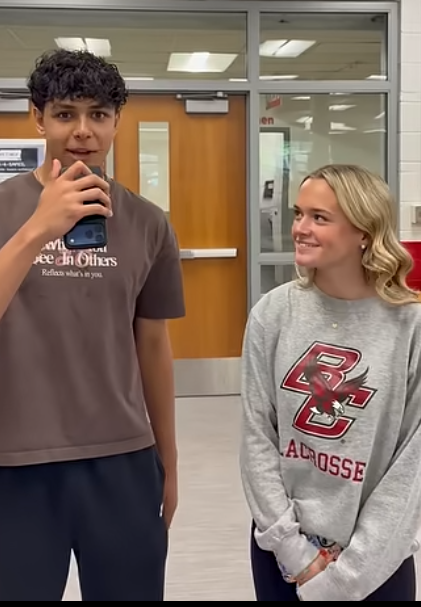
“[We] believe that the biggest difference between a relationship and a ‘situationship’ is clarity and commitment,” said Niko Miceli, senior, referring to himself and his girlfriend, Isabella Chiaramonte. “In a situationship, the communication can be inconsistent which creates confusion and uncertainty. However, in a relationship, there is a shared understanding of where things are going.”
As students attempt to navigate potentially difficult relationships, whether they’re friendly, romantic or somewhere in between, communication remains important. Miceli said something, in this aspect, very similar to Hutcheon and Swies.
“When we face misunderstandings, we always make sure to listen to one another,” Miceli said. “Taking time to hear each other’s side instead of assuming and explaining how we feel. It’s never about ‘winning’, but rather about understanding each other better.”
For students who may want more traditional clarity, he emphasized the importance of having direct conversations about the status of a relationship.
“We think that labels do matter because it provides clarity between both people,” Miceli said. “Without labels, each person is confused as to where [it] stands and how to move forward.”
He said that, no matter what label may exist in a relationship, communication is key.
“Our advice to someone who is unsure whether they’re in a relationship or just a situationship would simply be to talk,” Miceli said. “These conversations are hard, but they are needed in order to figure out the future.”